Most people would agree that electricity and water do not mix. I’ve even heard parents caution their kids against showering during a thunderstorm. Let’s just say that the modern-day caution surrounding electricity was not necessarily shared by our 19th century ancestors.
The market of the 1800s became saturated with electronic goods. People thought that the magical currents could do just about anything. Some popular products included electrified corsets, belts, chairs, tubs, and hairbrushes (which you can read more about HERE). Despite what you might think, Galvanic tubs were relatively safe because they were made of porcelain and had no metal drains. Electrodes connected to batteries were placed in the water and emitted a low current. Most patients experienced only minor tingling while extreme reactions involved a fainting spell.
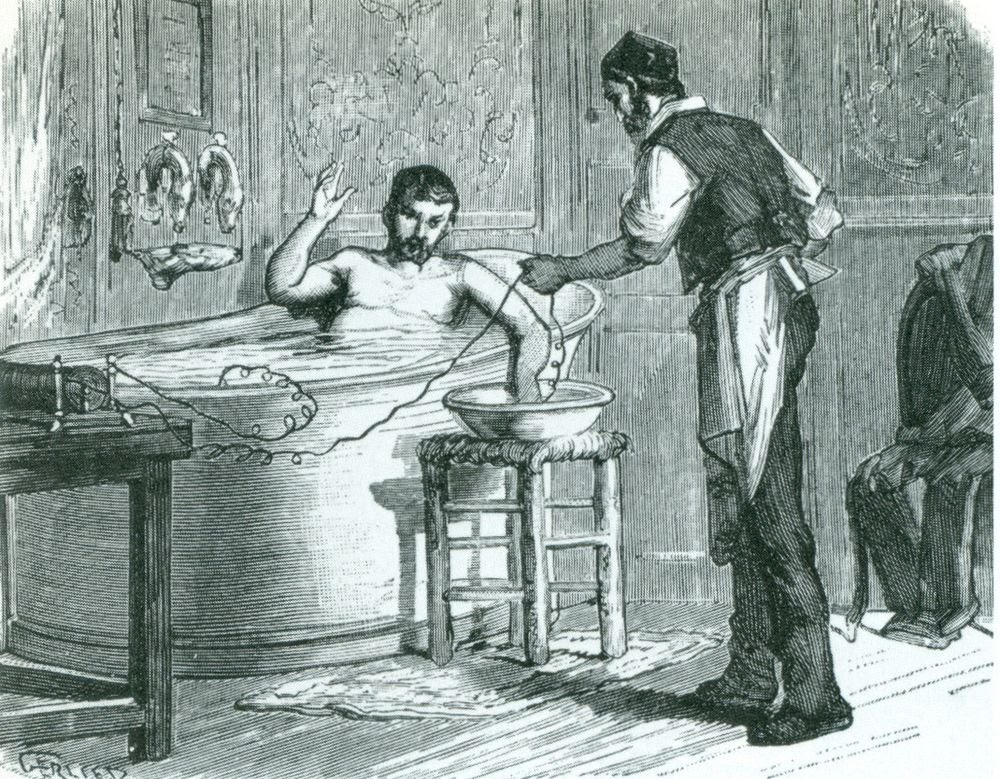
The baths were thought to offer relief from migraines, arthritis, skin disorders, and some psychological disorders including hyperactive nerves. The tubs are named after Luigi Galvani, an Italian scientist best known for his frog leg experiments. He discovered that the legs of dead frogs would twitch and flop about when electricity was applied. He was fascinated that the extremities of the animal also held the capacity to move when a nerve was pressed on. His work would later go on to inspire the classic novel, Frankenstein.

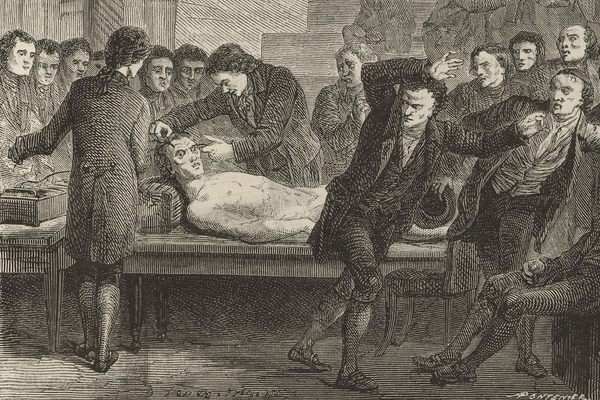
Luigi’s nephew, Giovanni Aldini, worked alongside him and would be known to perform a few terrifying experiments himself. In 1803, George Foster, was sentenced to death by hanging for the murder of his wife and infant child. After death, his body was to be given up for dissection. Aldini collected the body of the deceased after the punishment had been carried out and he proceeded publicly in applying electric shocks to the body which caused it to move. Passersby were shocked by what they saw and concluded that the man had been brought back to life. The court ordered that an executioner be present for the duration of Mr. Aldini’s experiments to ensure that George Foster remained departed.
In the 1870s, galvanic tubs became a popular treatment option for patients with rheumatoid arthritis. The baths were thought to reduce inflammation in the joints and offer pain relief. Jennie Kidd Trout, an advocate for galvanic tub treatments, was a pioneer in arthritis research and she was also one of the very first medically licensed females in Canada. Over a full-size tub, she favored 4 celled baths. Patients could receive treatment without changing into swimsuits, thus making appointments more convenient. On top of that, the electric current could be altered per extremity if the need arose.

Although electrified baths seem like a comical idea today, medical professionals are still discovering uses for electricity. Records indicate that even ancient Roman physicians were known to use electric fish for purposes of pain relief. Today, those suffering from arthritis can find relief via nerve stimulation involving electrical currents. Perhaps the baths weren’t so nutty after all. Nevertheless, keep electronic devices far away from your bath water and leave it to the professionals.
Until Next Time
N.F.
Sources:
Hippensteele, Alana. “Fun Fact: What Were Electric Baths Used to Treat in the 19th Century?” Pharmacy Times. Accessed 5 October, 2023. https://www.pharmacytimes.com/view/fun-fact-what-were-electric-baths-used-to-treat-in-the-19th-century.
· Mesler, Bill. “The Shocking Truth About Electric Baths.” Web MD. Accessed 5 October, 2023. https://www.webmd.com/rheumatoid-arthritis/features/electric-galvanic-baths-rheumatoid-arthritis.
“The Little Known History of Electrotherapy.” Tens Unit Hub. Accessed 5 October, 2023. tensunithub.com/history-of-electrotherapy/.

 Antiquated Antidotes