Many people are familiar with Ivan Pavlov, the scientist known for his work on salivation in dogs. His experiments focused on a type of learning called classical conditioning. Pavlov observed that dogs would start drooling in anticipation of food. However, he also noticed that the dogs would begin to salivate in response to stimuli unrelated to food, such as the sound of his assistant’s footsteps, because they had learned to associate those sounds with mealtimes. Building on this, Pavlov conducted further experiments, using a bell to condition the dogs to salivate at the sound of the bell alone. His research laid the groundwork for an influential experiment conducted by John B. Watson and Rosalie Rayner at Johns Hopkins University from 1919-1920. They aimed to test whether classical conditioning could also apply to humans, a study that would later become infamous for its controversial ethical implications.

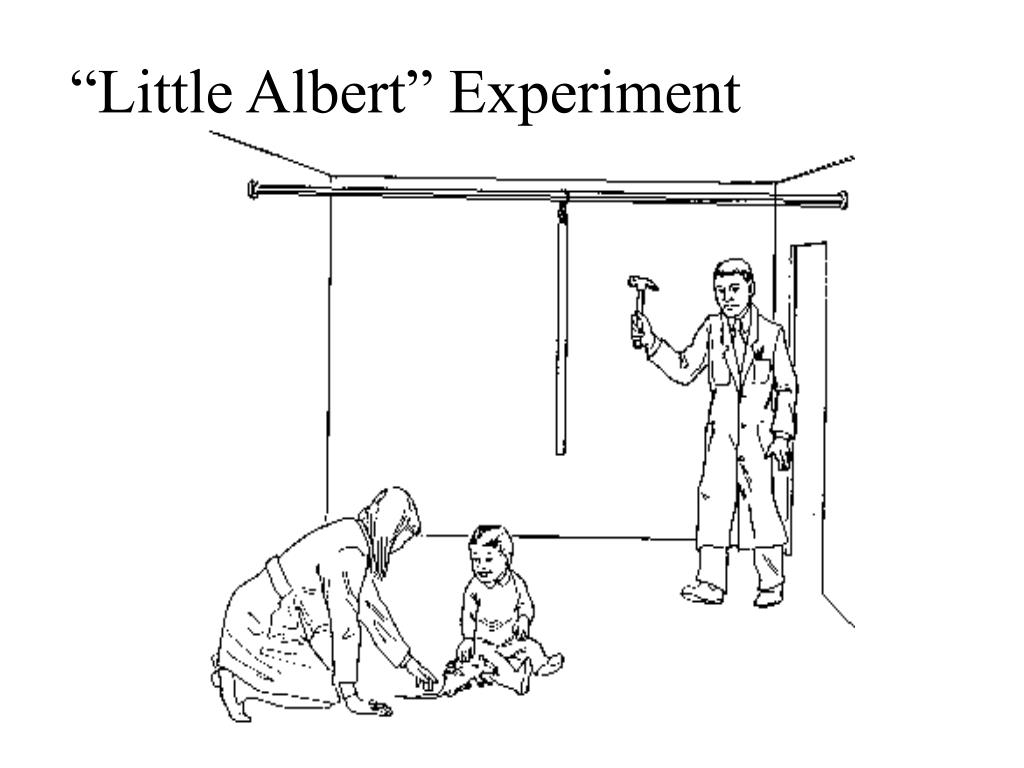
The experiment’s test subject was a 9-month-old baby referred to as “Little Albert.” At the start of the tests, it was determined that Albert had no negative reactions/fear responses to rats, rabbits, monkeys, masks, and other fuzzy things. Albert was then put through a series of sessions where a white rat was presented and then immediately a hammer struck a metal pipe behind Albert, starling him. After a few sessions of this, he began to show a fear response and cried and tried to crawl away anytime the rat was presented. This fear bled into many fuzzy things including a Santa mask. Before deconditioning could take place, the baby’s mother checked him out of the facility and did not return.
The fate of Little Albert remains a mystery. There are several guesses as to the true identity of Albert, but we don’t know for sure the lasting effects the experiments had on him as he grew into an adult. Perhaps he had a discomfort around fuzzy animals and refused to be around them. Hopefully he experienced no lasting repercussions. The experiment, although controversial, was useful in showing the impact of early traumatic experiences and how those experiences can ultimately shape our emotional responses. This meant that some fear responses and behaviors can be conditioned in us and are not necessarily all innate. This information revolutionized the understanding of the human psyche.
Until Next Time
N.F.
Sources:
- Giacomazzo, Bernadette. “Inside the Horrifying Little Albert Experiment that Terrified an Infant to the Point of Tears. ATI. October 13, 2022. Accessed 29 January, 2025. Allt hatsinteresting.com/little-albert-experiment.
- “Little Albert Experiment: Controversial Study on Conditioned Emotional Responses.” Neurolaunch. October 18,2024. Accessed 29 January, 2025. Neurolaunch.com/little-emotional-albert/.
- McLeod, Saul. “Little Albert Experiment (Watson & Rayner). Simply Psychology. November 14, 2023. Accessed 29 January, 2025. Simplypsychology.org/littlealbert.html.

 Antiquated Antidotes