Much of Clark Stanley’s life remains shrouded in mystery, with the details of his rise to fame lost to history. What is known, however, is that he gained notoriety for peddling ‘snake oil’ as a miraculous cure-all. Not only did Stanley earn infamy for his fraudulent claims, but the term ‘snake oil’ has since become a euphemism for scams and deceit. The ‘oil’ he sold contained no actual snake oil; instead, it was a concoction of ineffective ingredients, offering no real health benefits.
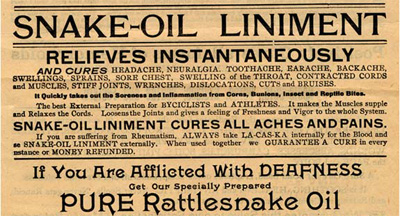
Stanley provided the public with some general background information in regards to how he came upon his medical knowledge. According to him, he was born in Texas C. 1854 and worked as a cowboy most of his life until meeting a Hopi medicine man and studying the art of making healing snake oil. The details of his life story were never verified and there is a real possibility that he never worked with any medicine man. Apparently, Clark Stanley used his flare for theatrics to his advantage in order to advertise his product at the World’s Columbian Exposition. While on stage, he pulled out a large snake from a bag, killed it and made a slit down it’s body before throwing it into a pot of boiling water. The fat rose to the surface and that is what he claimed to use in his precious products. People were awestruck by the showmanship and eager to see if the larger-than-life claims were true.

Stanley produced advertisement’s insisting that his snake oil could cure joint pain, rheumatism, chill blains, toothaches, sprains, bites, swellings, body aches, fevers, blisters and so on. It seemed that there was nothing that snake oil couldn’t do. By 1916, as a result of the Pure Food and Drug Act of 1906, the true ingredients in Stanley’s concoction came to light. His product contained mineral oil, beef or pig fat, chili peppers, and turpentine. After 2 decades of deceit, the rattlesnake king’s lies were revealed and he was fined.
Sometimes if it sounds too good to be true, then it really is too good to be true! Don’t trust everything you are told. Unfortunately for our ancestors, many of them most likely lost their hard-earned cash on fraudulent trash.
Until Next Time,
N.F.
Sources:
- “Clark Stanley’s Snake Oil Liniment.” National Museum of American History. Id Number:MG.293320.1380Catalog Number:293320.1380Accession Number:293320. Accessed 5 February, 2025. https://americanhistory.si.edu/collections/object/nmah_1298331.
- “Friedman, Jordan. “How Snake Oil Became a Symbol of Fraud and Deception.” Smithsonian Magazine. October, 21, 2024. Accessed 5 February, 2025. https://www.smithsonianmag.com/innovation/how-snake-oil-became-a-symbol-of-fraud-and-deception-180985300/.

 Antiquated Antidotes